
Shift & station planning
Who stands where, for every block of the day
The gap between a schedule and a shift
Scheduling software solves hours. It is very good at hours. The part it hands back to you is the part that actually decides how the shift goes: given these bodies and these hours, who covers which station through the lunch push, who moves when the 2pm leaves, and what breaks when one person calls out.
Most operators do that in their head, on a whiteboard, twenty minutes before the rush. That works when the manager doing it has been there four years, and falls apart on their day off.
What the planner does
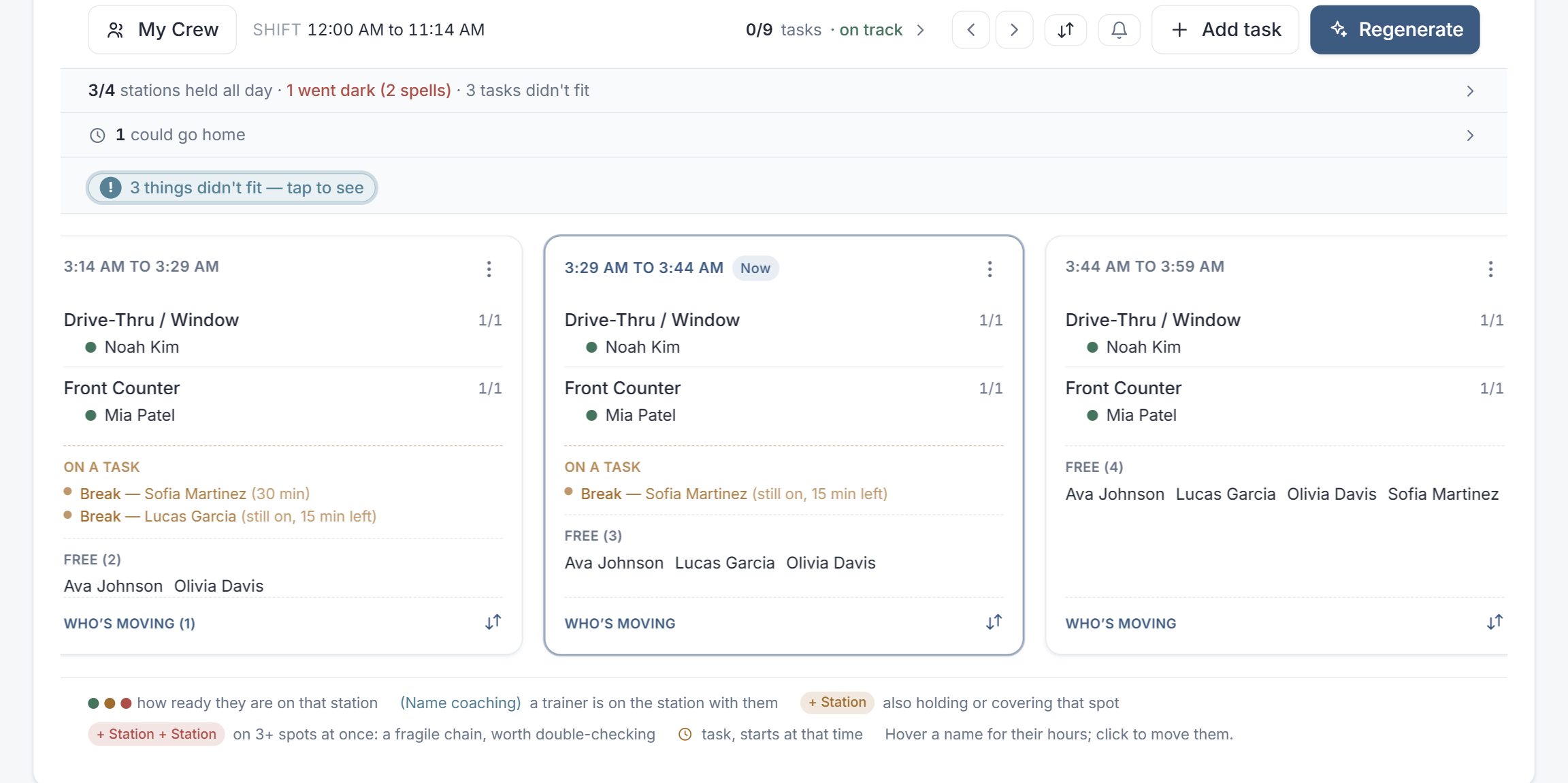
- Generates a whole-day, block-by-block plan of who is on which station, in one click.
- Only places people the training records say can hold the station, and will not leave someone unlearned standing alone on one.
- Places shift tasks into blocks where the floor can absorb the damage, instead of pulling a hand off the line at the worst moment.
- Says out loud what did not fit: the station that went dark, the task it could not place, and who could go home.
- Takes hand edits on any cell, and keeps them through the next regenerate.
- Slides horizontally through the day and flips to show who is moving between blocks.
It is only as honest as the training data
That is a feature, not a caveat. A planner that assumes everybody can do everything produces a clean grid and a bad shift. Because this one reads the same records as the cross-training matrix, the plan degrades honestly: thin coverage shows up as a warning with a named reason and a fix, not as a silently filled cell.
Which is also why the two halves of CrewSharp belong in one product. Evaluations feed readiness, readiness feeds the plan, and the plan tells you where to train next.
Common questions
Does CrewSharp replace my scheduling software?
No. It reads the schedule you already publish and plans stations inside it. Who works Tuesday and for how long stays in HotSchedules, 7shifts or whatever you run. CrewSharp answers the next question: given those people and those hours, who stands where, block by block.
Will it put an untrained person on a station?
Not silently. The planner reads the same training records the cross-training matrix does. If a station cannot be covered by anyone trained, it says so and names the reason rather than filling the slot and hoping. It also refuses to leave someone who has not learned a station standing on it alone when a comfortable teammate could take it.
Can I hand-edit the plan?
Yes, any cell. Hand edits are recorded as a durable layer over the plan, so regenerating does not quietly wipe them, and you get a cut-point prompt when a regenerate would conflict with something you set on purpose.
What does it tell me when the plan does not work?
Plainly what did not fit: which station went dark and why, which shift task it could not place, and who could be sent home without hurting coverage. A planner that silently produces a pretty grid over an impossible day is worse than useless.
Can I use it to plan training into a shift?
That is one of the main reasons it exists. Because it knows who is thin on what, it can pair a trainee with a coach during a block where the floor can absorb it, one trainer to one trainee, prioritising whoever knows the fewest stations.
Plan a real day before you commit to anything
Import a week of schedule, generate the plan, and see whether it matches the one in your head. Where it disagrees is usually the interesting part.
30 days free. No card to start. Cancel in one click.
Keep reading
For HotSchedules users
Import the Extended Schedule Report and plan stations on top of it.
Cross-training matrix
The readiness data the planner reads before it places anyone.
Quick-service restaurants
What this looks like when the whole day is one long push.
Pricing
Planner included. One price per store, nothing per seat.