
Coffee shops & cafes
Barista training tracked the way a bar actually works
Why one 'barista' label hides the problem
Nearly every cafe records training as a single level: trainee, barista, senior barista. It is convenient and it obscures the thing you need on a Saturday morning, which is whether this specific person can dial in the grinder when the shots start running fast.
Split it. Espresso and milk are separate skills that fail in different ways. Batch brew and cold bar are procedure-heavy and easy to get wrong quietly. Open and close carry the calibration and the equipment care that decide whether tomorrow goes well, and they are usually taught by whoever happened to be on that morning.
Skill decay is faster here, so dates matter more
A part-timer who has not been on bar for six weeks is not where they were. That is not a performance problem, it is normal, and it is why every sign-off in CrewSharp carries the date it was confirmed and by whom.
- A per-station re-check interval, so an old sign-off reads as unconfirmed rather than as a pass.
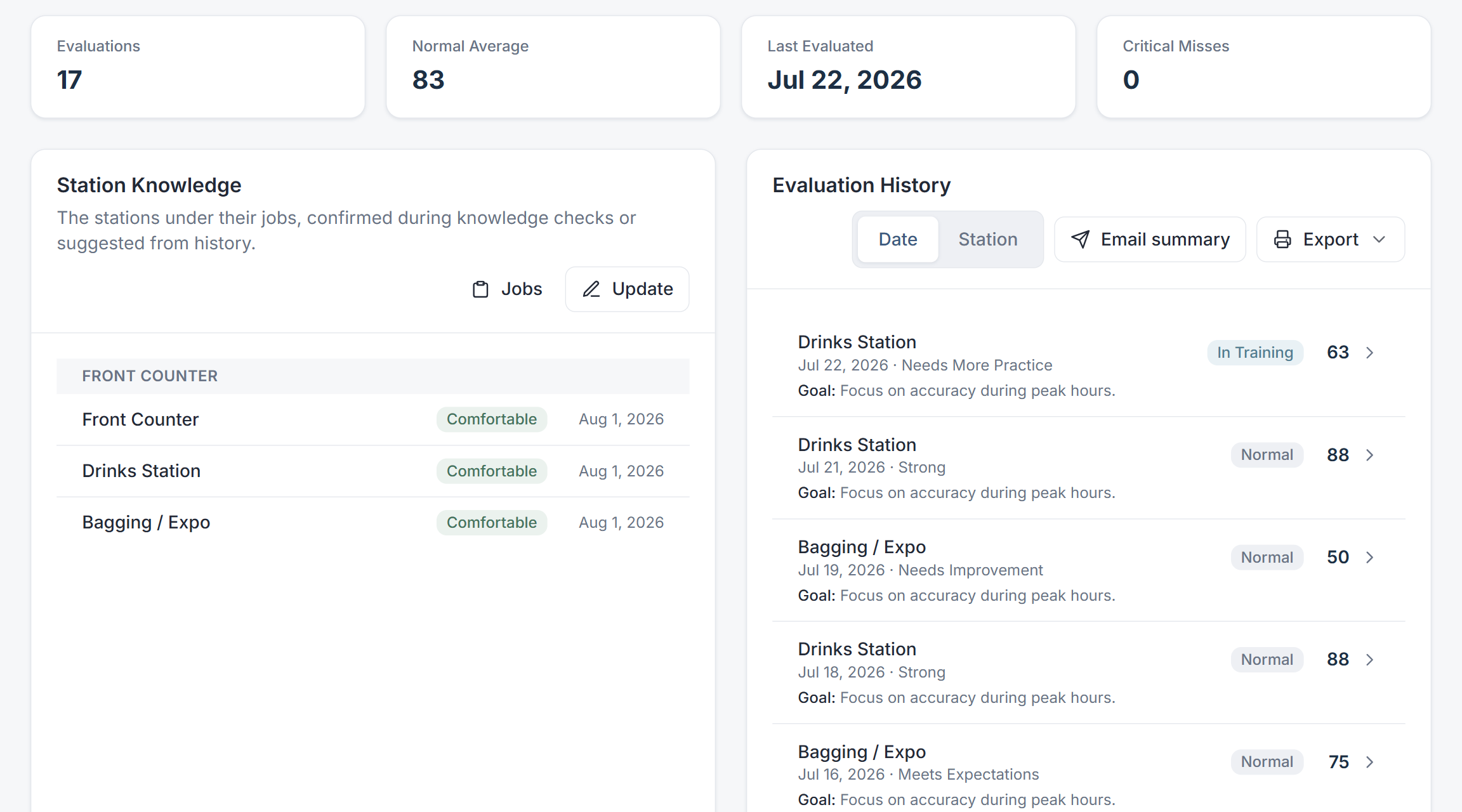
- The person's full history in one place: what they are comfortable on and when it was last confirmed.
- Most-missed checklist items across the crew, which in a cafe usually points at a recipe card or a grinder rather than at people.
- Knowledge checks a trainer records deliberately, which outrank a merely good score.
Common questions
How do you track barista training and sign-offs?
Treat each part of the bar as its own station with its own bar for sign-off: espresso and milk, brew and batch, cold and blended, register, food and pastry, and open/close. Record who signed the barista off and when, because espresso skill decays faster than most restaurant skills and a sign-off from a year ago is not evidence about today. Food-handler cards and other credentials with an expiry date are outside what CrewSharp stores, so keep those wherever you keep them today.
What should a barista training checklist include?
Observable actions rather than knowledge: dose and yield checked against the recipe card, shot timing within range, purge and wipe between drinks, milk textured to the right temperature without a second pitcher, correct grind adjustment when the shot runs fast or slow, and calibration or dial-in at open. 'Understands extraction' is not checkable; 'adjusts the grinder correctly when shots run at 18 seconds' is.
Does it handle part-time and student staff?
Yes. Team members are unlimited and pricing is per store, so a large roster of part-timers costs the same as a small one of full-timers. Because every sign-off is dated, it is also easy to see who has not worked a station recently enough to still be reliable on it.
We only have one shop. Is this overkill?
It depends on whether you can answer, right now, who is signed off to dial in the grinder at open. If that lives in one person's head and they take a holiday, the record is worth having. If you would rather start on paper, the free training matrix template is a fine first step and we will tell you where it breaks.
Set your bar stations up in an afternoon
Start from a cafe starter pack, edit the checklists into your own standards and recipe cards, and run a real sign-off on the next shift.
30 days free. No card to start. Cancel in one click.